
Don’t Just Legalize Housing. Place Limits on Local Regulation Altogether.
California’s backyard-home boom shows us how states should design preemption of local land use regulation.
This essay summarizes my findings from my working paper.
A decade ago, almost nobody in California received a permit for a backyard home. Then, the state’s suite of permitting reforms in 2016 caused a surge. Now, accessory dwelling units (ADUs) – small, self-contained units built in backyards, garages, and basements of existing residential properties – are nearly one in five new homes in the state. I argue that a central ingredient in the success of the reforms was the limits the Golden State imposed on local regulation.
What California Did. Local land use regulations suppress new housing construction, so states aiming to increase housing supply are often interested in preempting them. Rather than remove one local barrier at a time, California established the maximum standards a locality could apply to an ADU. With few exceptions, any ADU meeting the state’s standards was permitted by-right (without case-by-case review) and a locality could not layer on additional standards. I call this a regulatory ceiling.1
Regulatory ceilings are promising because localities can impose a wide array of barriers to new housing. Zoning, design standards, setback requirements, impact fees, and case-by-case permit review impose barriers to new housing “by a thousand cuts.” Localities can also respond to the removal of one barrier with the imposition of another. One California city responded to state duplex legalization by requiring that qualifying lots contain three mature trees. A legislative aide who worked on the reforms described removing barriers one by one as a “cat-and-mouse” game with local authorities. A regulatory ceiling circumvents this entirely.
California’s reforms provided a natural experiment to test my argument. The 2016 package of ADU reforms created a broad regulatory ceiling for ADUs on parcels with a single-family home; multi-family parcels (duplexes, triplexes, fourplexes) were still subject to substantial local control. For the most part, single-issue reforms in the package – like lifting parking requirements near transit or streamlining fire sprinkler requirements – applied to both single- and multi-family parcels. It was only in 2020 that the state extended the ceiling to multi-family parcels.2 Thus, to understand how much the regulatory ceiling drove an increase in permitting, we can compare these two parcel types over this period. If the ceiling matters, we should see permitting surge on single-family parcels after 2016 and then see multi-family parcels surge in the same way after 2020. Assembling permit data from Los Angeles and San Francisco, this is exactly what I found.
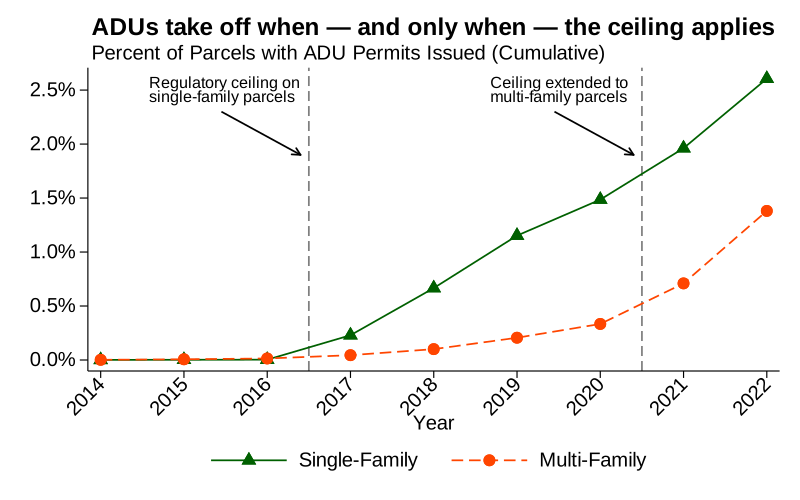
By 2020, the percentage of single-family parcels with an ADU permitted had risen to 1.5%, 1.2 percentage points higher than multi-family parcels. After 2020, the pattern reverses: multi-family permitting rates jump and their growth begins to match the growth single-family parcels experienced after 2016. The timing of these surges is evidence of the regulatory ceiling’s effect.
Further analysis shows that the effect of the regulatory ceiling on ADU permitting is twice as large as the effect of removing parking requirements.3 Additional evidence that the ceiling mattered comes from the fact that many ADUs appear to be just less than 1,200 square feet, the size threshold below which state protection applies. This suggests that builders who might have otherwise built larger ADUs are building smaller ones to stay inside the protections provided by the regulatory ceiling.
Lessons for Policymaking. Many states are now drafting ADU legislation, and more are considering some preemption of local land use regulations. The lesson from California’s ADU experience is that reforms that legalize housing but leave localities free to attach their own conditions fail to produce additional housing, as California’s own experience with past ADU reform shows. Successful preemption of local land use regulation may instead require placing a ceiling on local authority.
I’m adapting language from the federalism literature on “ceiling preemption”. ↩
Like the 2016 reforms, most other parts of the 2020 reform package applied equally to single- and multi-family parcels. ↩
California prevented localities from imposing parking requirements on ADUs built within a half mile of a transit stop. ↩
Posted: